A Flickering Light in the Cosmos
In the vast night sky, filled with countless stars that shine with predictable consistency, one star stands out as a true enigma. Officially named KIC 8462852, but widely known as Tabby’s Star, this distant sun has puzzled astronomers and sparked imaginations across the globe. First observed displaying irregular dimming patterns in 2015, Tabby’s Star has become a focal point for both serious scientific investigation and bold speculation. Among the most provocative theories? That an alien megastructure, possibly a Dyson sphere, could be orbiting it.
While the idea of extraterrestrial technology may sound like science fiction, the mystery of Tabby’s Star remains unsolved. And the more we learn, the stranger it seems.
Discovery and the Unusual Behavior
Tabby’s Star, located about 1,470 light-years away in the constellation Cygnus, first came to public attention thanks to data from NASA’s Kepler Space Telescope. Kepler’s mission was to detect exoplanets by monitoring the brightness of stars; a slight dip in light could indicate a planet passing in front.
But Tabby’s Star didn’t behave like the others. Instead of regular, periodic dips in brightness consistent with an orbiting planet, this star flickered irregularly and drastically, sometimes dimming by as much as 22%, a level unheard of from any known natural cause. And these dips didn’t follow a clear, repeating pattern. Some were sudden and sharp; others were slow and long-lasting. Over four years, the star's light output dropped significantly, a long-term dimming that added another layer to the puzzle.
These patterns were so bizarre that they couldn’t be explained by common astronomical phenomena like exoplanets, asteroid belts, or stellar variability. Something strange was happening, something that didn’t fit into any neat scientific box.
Who Is Tabby?
The star’s popular nickname comes from Tabetha Boyajian, the astronomer who led the original team analyzing its strange behavior. In a paper published in 2015, Boyajian described the dips as “bizarre” and unlike anything seen before. Despite her careful language and scientific rigor, the door was left slightly ajar for wilder interpretations. And the world rushed in.
Soon, Tabby’s Star was catapulted into the spotlight, gaining attention not only from the scientific community but from the public and media. What if the dimming wasn’t caused by dust or debris, but by something far more intentional?
The Dyson Sphere Hypothesis: A Glimpse into Alien Engineering?
Among the many explanations offered, one captured the public imagination more than any other: a Dyson sphere.
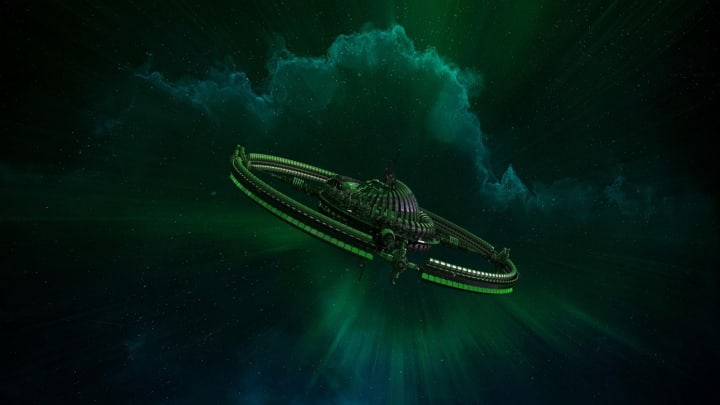
Proposed by physicist Freeman Dyson in 1960, a Dyson sphere is a hypothetical megastructure built by an advanced civilization to capture energy from its star. In theory, a civilization far more advanced than ours (a Kardashev Type II civilization) could surround its host star with solar panels, satellites, or a shell-like structure to harvest stellar energy.
If such a megastructure existed, it could explain the irregular dimming of Tabby’s Star. Instead of planets or space dust, we might be witnessing gigantic alien constructs orbiting and partially blocking the star’s light. This idea was so compelling that scientists at the SETI Institute (Search for Extraterrestrial Intelligence) trained their telescopes on Tabby’s Star, hoping to detect radio signals or other signs of artificial activity. But no definitive signals have been found… yet.
Still, the possibility couldn’t be ruled out, because the natural explanations weren’t holding up either.
Natural Theories: Dust, Comets, and Collisions
Of course, scientists are cautious and skeptical by nature. While the Dyson sphere idea is fascinating, the scientific community has worked hard to find more mundane explanations.
One of the earliest theories suggested a swarm of comets orbiting the star. If a large family of comets passed in front of Tabby’s Star, their combined tails could cause irregular dimming. However, this didn’t explain the sharpness and depth of some of the dips, and it certainly didn’t account for the long-term dimming over the years.
Another theory involved interstellar dust. Dust grains could block certain wavelengths of light more than others, leading to strange dimming patterns. Observations in infrared, however, showed no significant excess heat, which would be expected if dust were absorbing the star’s light and re-emitting it. There were also models involving planetary collisions, massive debris clouds from the destruction of moons or planets. But again, none of these theories could fully explain all the data. Each had holes, contradictions, or missing evidence.
What Makes This So Unique?
The more astronomers studied other stars, the more it became clear: nothing else looks like Tabby’s Star.
Kepler monitored over 150,000 stars, and this was the only one that exhibited this bizarre behavior. That rarity makes the case even more compelling; whatever is happening here is unusual, maybe even unique. Moreover, the dimming occurs across many different timescales, from short, sharp drops to slow fades over years. It doesn’t match any known class of variable stars. And the depth of the dips is too large to be caused by exoplanets or rings.
If it’s a natural process, it’s one we’ve never seen before. If it’s artificial, it could be the first evidence of advanced alien engineering ever detected.
Recent Developments and Ongoing Research
Since the initial discovery, scientists have continued monitoring Tabby’s Star using ground-based telescopes and follow-up missions. Interestingly, some of the recent dips have been observed again, confirming that the star continues to behave strangely.
Tabby Boyajian has led a crowdfunding campaign called “Where’s the Flux?” to raise money for continued observation. The campaign was a massive success, showing how invested the public has become in solving this cosmic riddle. Meanwhile, infrared and submillimeter observations have ruled out many traditional explanations. And while no alien signals have been detected, the sheer strangeness of the star continues to keep the alien megastructure theory alive, not as a certainty, but as a valid and fascinating possibility.
A Cosmic Riddle That Won’t Go Away
Tabby’s Star challenges our understanding of the universe. It refuses to be explained away easily. And while many scientists lean toward natural explanations, no consensus has been reached. The idea that we might be witnessing the handiwork of an intelligent civilization is still on the table, not because it’s likely, but because we don’t know.
As technology advances and new telescopes like the James Webb Space Telescope come online, we may eventually unlock the secrets of this flickering star. Until then, Tabby’s Star remains one of the greatest mysteries of modern astronomy, a cosmic question mark, shimmering in the sky, daring us to figure it out.
Comments
Post a Comment